You're earning tax-free in the Gulf and you want to invest it properly. Not in an offshore savings plan with a 25-year lock-in and 5% annual fees. Not in a regional app that forces you into US-domiciled funds. In a real, low-cost, globally diversified ETF that compounds quietly in the background while you get on with your life.
This guide explains the VWRA listing, how to fund an Interactive Brokers account and which costs to compare before placing an order. Your bank, broker account and transfer route all affect the cost.
The short version, if you want to skip ahead:
- Check account eligibility and compare Interactive Brokers pricing plans
- Generate USD deposit instructions and check the bank quote and charge option
- Keep USD available for the USD-quoted VWRA listing
- Buy VWRA on the London Stock Exchange with a limit order
- Choose a funding schedule using your actual fees and savings plan
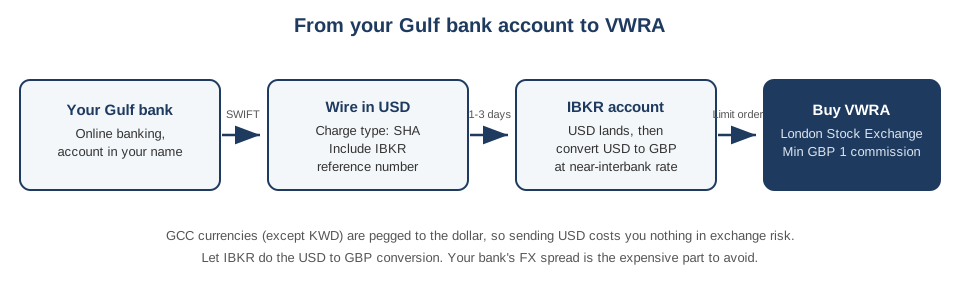
Everything below explains the why and the how, country by country.
Why VWRA and not a US ETF
Before the platform and transfer questions, this one needs answering properly because it catches a lot of people out.
You might have heard of VOO (Vanguard S&P 500) or VT (Vanguard Total World). Both are excellent funds. Neither is right for you if you're not a US citizen or US resident.
Here's why. The US withholds 30% of dividends paid to non-US investors unless a tax treaty with their country of residence sets a lower rate (IRS Publication 515). The UAE, Qatar, Saudi Arabia, Kuwait, Bahrain and Oman have no income-tax treaty with the US (the IRS treaty list), so a Gulf resident holding a US-domiciled fund loses 30% of every dividend. On a fund yielding 1.5% to 2% annually, that's not catastrophic, but it's a permanent drag that compounds against you over decades.
Far more dangerous is the US estate tax. Shares in US corporations, including US-domiciled ETFs such as VOO, are US-situs assets whatever the underlying stocks are. If a non-resident non-citizen dies holding more than $60,000 of US-situs assets, the estate must file a US return (IRS estate tax guidance for nonresidents). The tax is graduated up to 40%, and non-residents get a credit of only $13,000, which covers the first $60,000 (Form 706-NA instructions). For someone with $200,000 in VOO, that's a potential bill of about $41,800 landing on your family. An estate-tax treaty can change this: the UK-US treaty can exempt US shares for someone it treats as UK-domiciled (Taylor Wessing), but UK domicile rules changed in April 2025, so take advice before relying on it.
VWRA, the Vanguard FTSE All-World UCITS ETF (Accumulating), listed on the London Stock Exchange, solves both problems. It's domiciled in Ireland, which means the dividend withholding tax on US stocks inside the fund drops from 30% to 15% via the US-Ireland tax treaty. Units in an Irish fund are not shares in a US corporation, so they are not US-situs assets for US estate tax.
VWRA holds around 3,600 stocks across developed and emerging markets, has a 0.14% ongoing charges figure, following the reduction effective 28 July 2026, and automatically reinvests dividends rather than paying them out as cash. That last point matters more than it sounds. No cash sits idle in your account waiting to be reinvested, and you pay no extra trading costs every time a dividend lands.
For the London VWRA listing, check that your broker offers access to that security as well as the exchange. A platform offering US-listed ETFs or local shares does not automatically offer VWRA.
Why Interactive Brokers
IBKR is the platform used in this walkthrough. Compare the costs for your expected order size, funding currency and account entity before choosing a broker. A low dealing commission can be outweighed by bank transfers, currency conversion or custody charges.
These are published terms checked on 2 October 2026, not personalised quotes:
For USD-quoted UK shares, the first Tiered band is 0.05%, minimum USD 1.70, plus applicable third-party charges. Check: Listing access, pricing plan, order size, bank funding costs and any additional services.
Its MENA schedule lists stock/ETF custody rates are 0.15% for Classic/Platinum and 0.05% for VIP; the page says residence can change the rate. Currency conversion is quoted at up to 0.50%. Check: Your actual custody rate, commission minimum, account currency, entity and any applicable tax.
Its Swiss schedule lists UK share commissions in trade-value bands and fees shown in CHF. Check the band for your trade size. Check: Your contracting entity: Swiss and European pricing differ. Check the relevant custody, FX and trading terms.
Its supported-assets page excludes stocks and ETFs on non-US exchanges. Check: Do not assume it offers the London VWRA listing. Other Sarwa products have separate terms.
Its published offering includes US securities and local stocks. That does not establish London VWRA access. Check: Confirm the exact security and exchange in the app before choosing it for VWRA.
If you need to convert currency at IBKR, distinguish manual FX trades from automatic conversion. The spot-currency schedule lists a USD 2 minimum in the first manual-trade tier; automatic conversion typically adjusts the exchange rate by 0.03% without a separate commission. Funding the USD VWRA listing with USD avoids a USD-to-GBP conversion, but not any conversion cost charged by your sending bank.
Two rules before you wire anything
Rule 1: compare the amount that arrives, not just the sending fee. Include the bank fee, FX spread, applicable taxes and intermediary or receiving-bank deductions. SHA normally shares charges, OUR puts charges on the sender and BEN puts them on the beneficiary. Check the bank's handling of your chosen route; neither SHA nor a zero advertised sending fee guarantees a particular net amount received.
Rule 2: use the deposit instructions for your own broker account. Create the deposit notification in Client Portal and copy its beneficiary bank, currency and payment reference. Use a sending account in your own name. IBKR's funding guidance says it generally discourages and reserves the right to reject third-party deposits. A wallet or low-cost remittance service must support those instructions and identify the sender correctly; a cheap family-remittance corridor is not proof that it can fund a brokerage account.
Transfer options country by country
The information below concerns published sending charges and product conditions. It does not establish the complete cost of a successful transfer to IBKR. Check the exact beneficiary country and bank generated for your account.
UAE
HSBC Global Money describes transfers with no HSBC fees, but its exchange rate includes a conversion margin and non-HSBC payments can incur correspondent or receiving-bank charges. Its Global Money Transfers FAQ also distinguishes destination-local-currency payments from other payments, which can incur an HSBC fee. Do not describe every HSBC-to-IBKR wire as a zero-total-cost transfer.
Emirates NBD's personal tariff lists foreign-currency remittances through online/mobile/ATM channels as free. That is a bank charge, not a guarantee about FX or intermediary deductions. DirectRemit has destination, currency and recipient-bank restrictions; it is not interchangeable with a USD broker wire. For FAB, RAKBank or another bank, obtain a quote for the exact USD beneficiary account, including any additional charges.
Saudi Arabia
SAB's tariff, effective 20 February 2026, lists an electronic transfer outside Saudi Arabia at a maximum SAR 40 before VAT. Its lower SAR 15 rate is for specified remittance destinations, not every USD brokerage transfer. QNB Saudi Arabia's tariff lists a maximum SAR 50 electronically or SAR 75 at a branch, excluding VAT. These figures do not establish a complete transfer cost or a cheapest-bank ranking.
STC Bank's fee page describes international Western Union transfers. That does not establish acceptance of an IBKR beneficiary or originating-account details. Check the current destination, transfer method and quote instead of relying on a generic remittance price. Ask the provider to confirm the actual bank-transfer route before paying for a transfer.
Qatar
Commercial Bank's personal tariff lists QAR 15 for transfers to banks outside Qatar. Intermediary deductions depend on the route and charge option; ask what is expected to reach the broker.
Its 2026 bundle campaign offers retail packs of up to six transfers for QAR 70, twelve for QAR 120 or twenty for QAR 180. The offer runs from 31 March to 31 December 2026, with terms and conditions. Applicable correspondent charges are extra. QAR 70 divided by six is QAR 11.67 per transfer only if all six are used; that is the package component, not the complete wire cost. Check usage, expiry and beneficiary eligibility before buying a pack.
Compare the complete quote from CBQ, QNB or another bank for the same beneficiary and amount. A MoneyGram/Western Union remittance service also needs separate confirmation that it can meet your broker's funding requirements.
Kuwait
NBK's online-banking FAQ describes a KD 5 charge when the sender accepts charges, and possible beneficiary deductions when the beneficiary accepts them. KFH's FAQ describes no KFH fee for international telex transfers through its online service. Neither establishes a universal all-in cost: confirm the channel, currency, correspondent charges and current quote for the broker beneficiary. The sending charge alone is not enough to compare the two banks.
Bahrain
NBB's March 2026 tariff lists international/GCC SWIFT transfers at BHD 5.50 plus correspondent charges, if any. KFH Bahrain's tariff lists the same basic TT charge with correspondent charges additional. These are bank-fee components, not a complete USD funding quote or proof of the cheapest route.
Oman
Bank Muscat's published retail tariff, section 14.3, lists SHA SWIFT at OMR 5.25 including VAT and OUR at OMR 15.75 including VAT. SHA and OUR allocate charges differently, so compare the expected net credit as well as the sending charge. Confirm the tariff's applicability to your account, FX rate and what the chosen charge option covers.
Transfer costs at a glance
These are selected published bank-fee components, in local currency. They exclude other costs unless explicitly stated. Compare complete quotes in the same currency before choosing a route.
HSBC UAE Global Money
No HSBC fee described for the product Qualification: Product/route conditions, FX margin and intermediary charges matter.
Emirates NBD personal digital remittance
Sending fee listed as free Qualification: Different account packages, routes and other-bank charges need checking.
SAB electronic international transfer
Maximum SAR 40 before VAT Qualification: Restricted destination offers have different rates; not an all-in quote.
QNB Saudi electronic international transfer
Maximum SAR 50 before VAT Qualification: Branch and account/route conditions differ.
CBQ retail six-transfer pack
QAR 70 for up to six transfers Qualification: All six must be used for a QAR 11.67 package average; correspondent charges extra.
NBK online transfer, sender accepts charges
KD 5 in the FAQ Qualification: Confirm the actual beneficiary route and deductions.
NBB / KFH Bahrain international TT
BHD 5.50 Qualification: Correspondent charges additional where applicable.
Bank Muscat retail SWIFT
SHA OMR 5.25; OUR OMR 15.75, including VAT Qualification: Confirm the charge option, FX and account applicability.
Returning to the UK? The investing after returning to the UK calculator models pension and ISA allocation.
How often should you invest?
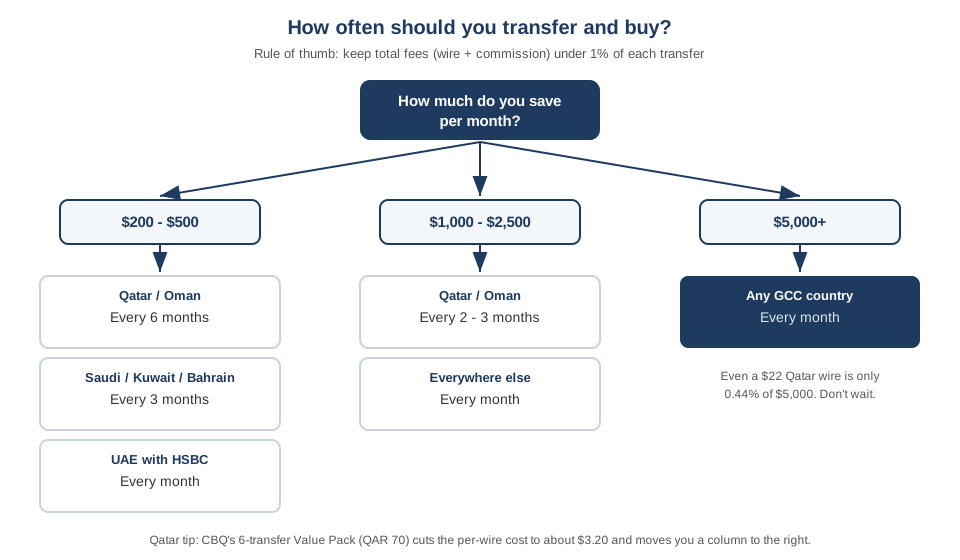
Use your actual costs to compare transfer sizes. A 1% fee target can be useful for planning, but it is not a rule requiring everyone to wait for a particular amount. Larger batches can reduce a fixed fee as a percentage of the transfer; a percentage-based FX spread does not disappear when you batch payments. Delaying an investment also changes your market exposure, and future returns may be positive or negative.
Illustrative example: assume a USD 20 bank fee and a USD 1.70 trading commission, with no FX spread or other charges. The combined cost is USD 21.70:
| Transfer amount | Example combined fee | Fee as a percentage |
|---|---|---|
| USD 500 | USD 21.70 | 4.34% |
| USD 1,500 | USD 21.70 | 1.45% |
| USD 3,000 | USD 21.70 | 0.72% |
This is not a quote for any country or provider. Trading commission can also change with order size. Recalculate using the amount credited to your broker and the order preview rather than assigning a six-month or monthly schedule based only on where you live.
Step 1: open your IBKR account
Go to ibkr.com, check eligibility for your residence and circumstances, and start an Individual account application. Required documents and approval timing depend on the contracting entity and the application.
This excellent YouTube video will help
Have these ready before you start:
- Your passport (a clear photo or scan of the photo page)
- Proof of address meeting the application's current document and date requirements
- Your employment details and a rough estimate of your income and net worth (IBKR asks for regulatory reasons; estimates are fine)
A few choices you'll make during the application:
Base currency. Choose USD. You'll be funding in dollars, and you can hold and convert multiple currencies inside the account regardless.
Trading permissions. Tick stocks and ETFs for the United Kingdom (and Europe if offered). You don't need options, futures, or margin for this.
W-8BEN form. As a non-US person, IBKR has you complete this electronically during the application. It certifies that you are not a US person, which avoids US backup withholding; a reduced treaty rate on US dividends applies only if your country of residence has a US tax treaty, and the Gulf states do not. It takes two minutes. Don't skip it.
Wait for approval and any further document requests before transferring funds. Follow the account's instructions to set up two-factor authentication.
Step 2: switch to Tiered pricing
Check the pricing plan selected for your account. Compare the plans for your order size and listing currency. For USD-quoted UK shares, the published minimum is USD 1.70 on Tiered versus USD 4 on Fixed SmartRouting; Tiered can add third-party charges. The GBP 1 Tiered minimum applies to GBP-quoted shares, not VWRA's USD listing.
- Log in to Client Portal
- Click the head-and-shoulders icon (top right) and open Settings
- Under Account Settings, find IBKR Pricing Plan (sometimes labelled Fee Structure)
- Change it from Fixed to Tiered and confirm
The change usually applies from the next trading day.
Step 3: fund your account by wire
- In Client Portal, go to Transfer & Pay, then Transfer Funds, then Make a Deposit
- Choose Wire Transfer and select USD as the currency
- Enter the amount you plan to send. IBKR generates funding instructions: its bank details plus a unique reference number tied to your account
Use your bank's supported transfer channel and those exact deposit instructions. Check the final quote before confirming. Three things to get right:
- Send in USD
- Check SHA, OUR or BEN, who pays which charges, and the expected amount received
- Paste the reference number exactly as IBKR gave it to you, usually in the "message to beneficiary" or "payment reference" field
That reference number is how IBKR matches the incoming money to your account. Miss it and your transfer sits in a holding queue until you raise a ticket, which can add days.
Transfer and crediting times depend on the banks, route, holidays and any checks. Confirm that funds are available in the broker account before placing an order.
If a transfer is rejected: ask the sending bank and broker for the reason before resending. A same-name sending account is important, but it does not guarantee that a transfer will clear.
Step 4: check the listing and cash currency
Vanguard lists VWRA in USD and VWRP in GBP on the London Stock Exchange. They are trading lines of the same accumulating share class, with ISIN IE00BK5BQT80. For the VWRA route described here, keep your funding in USD and check that the order ticket shows the USD listing.
If you choose the GBP-quoted VWRP line instead, you need GBP cash or an applicable broker conversion arrangement. Check the currency, trading permissions and conversion charges before submitting an order. The quote currency does not change the fund's underlying investments.
Sources checked 2 October 2026: Vanguard's factsheet, Vanguard's fee-change notice and IBKR's UK commission schedule.
Step 5: buy VWRA
- In the search bar, type VWRA and select the listing on the London Stock Exchange
- Open an order ticket and set the order type to Limit
- Set your limit price at or a touch above the current ask price. A limit order means you'll never pay more than the price you set; a market order on an ETF can occasionally fill at a poor price in thin moments
- Enter the number of shares your available USD cash covers, leaving room for fees. Review the order preview, including commission and any third-party charges, before submitting
The LSE is open 8:00am to 4:30pm UK time, Monday to Friday. If you place an order outside those hours it simply queues until the next open.
Check whether your displayed quote is live or delayed. A limit order caps the price you will pay, but execution is not guaranteed. Review the current market and order preview before submitting.
Step 6: repeat on schedule
Choose a schedule using your savings plan and the actual transfer and trading costs. When it fires: wire, check the USD balance and listing, buy. The whole cycle takes ten minutes once you've done it twice.
Resist the urge to check the balance daily, and resist the urge to time the market. The entire point of this setup is that it's boring. Boring is what compounds.
The bottom line
For this VWRA route, confirm the USD listing and account permissions, generate the correct deposit instructions, compare the complete funding cost and review the order charges. Compare an actual quote and choose the broker and schedule that fit your circumstances.
The Irish domicile keeps you out of US estate tax and halves the US dividend withholding suffered inside the fund, compared with the 30% a Gulf resident pays on a US-domiciled fund. The accumulating structure means no manual dividend reinvestment. The fund's 0.14% ongoing charges figure is separate from brokerage and bank charges. Check the broker's complete schedule for trading, funding, currency conversion, withdrawal and optional service charges.
The hardest part is the setup, an afternoon's admin to open the account and do the first transfer. After that, it runs itself.
Fees and regulations change. Verify current transfer costs with your bank and current brokerage fees at ibkr.com before investing.
Disclaimer: This article is for educational and informational purposes only. Nothing on ExpatMoneyMatters.com constitutes regulated financial advice. All figures and examples are illustrative. Your situation will differ. Always seek independent, regulated financial advice before making investment, mortgage or retirement decisions. Past performance is not a reliable indicator of future results.
Disclaimer: This article is for educational and informational purposes only. Nothing on ExpatMoneyMatters.com constitutes regulated financial advice. All figures and examples are illustrative. Your situation will differ. Always seek independent, regulated financial advice before making investment, mortgage or retirement decisions. Past performance is not a reliable indicator of future results.